Your shopping cart is empty!

DEFINITION OF INTEGERS
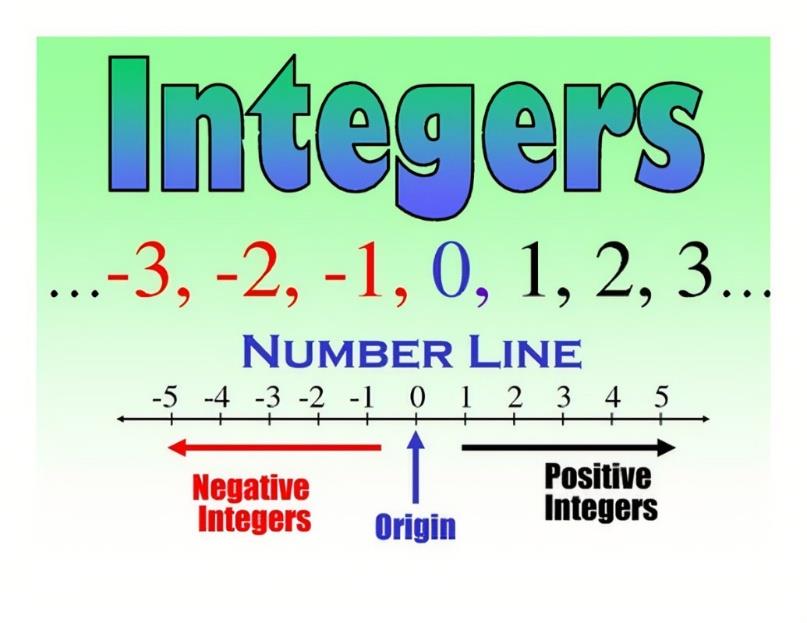
Integers is a word that originated from the Latin word “Intangere” which means whole or intact. In mathematics integers id referred to as a collection of numbers comprising zero, positive numbers and negative numbers. Integers do not include a fractional part; thus, we say, integers are numbers that can be positive, negative or zero but cannot be a fraction. The positive integers are natural numbers such as 1,2,3, 4, 5 and they are represented by a plus (+) sign although we do not write the sign on the side of the number ,we already know that if a number carries no sign beside it, automatically that number is positive and the positive numbers lie on The right side of 0 on a number line. The negative integers are the negative of natural numbers meaning they are the opposite of positive numbers such as -1, -2, -3, -4, -5 they are represented by a minus (-) sign written on the side of a number and the negative numbers lie on the left side of 0 on a number line. Zero is neither a positive nor a negative integer. It is a neutral number.
Integers include rules, properties and arithmetic operations that acts as a guideline that enables people to work with integers. If you apply a wrong rule when dealing with certain integers, the whole calculation becomes incorrect, but integers are not just numbers on a paper that are to be worked on they have a greater impact in one’s life in this paper I will give an outline of the rules, properties and real-world applications of integers on our daily lives.
RULES OF INTEGERS
- Sum of two positive integers is an integer
- Sum of two negative integers is an integer
- Product of two positive integers is an integer
- Product of two negative integers is an integer
- Sum of an integer and its inverse is equal to zero
- Product of an integer and its reciprocal is equal to 1
ARITHMETIC OPERATIONS ON INTERGERS
The arithmetic operations performed on integers are:
- Addition of integers
While adding the two signs of the same sign, add the fixed values, and write down the sum with the sign provided with the numbers.
- Subtraction of integers
While subtracting two integers, change the sign of the second number which is being subtracted, and follow the rules of addition. For example, (-7) – (+4) = (-7) + (-4) = -11
- Multiplication of integers
While multiplying two integer numbers, the rule simple. If both the integers have the same sign, then the result is positive. If the integers have different signs, then the result is negative. For example, (+2) × (+3) = +6 and (+3) × (-4) = -12
- Division of integers
The rule for dividing is similar to multiplication; If both the integers have the same sign, then the result is positive. And if the integers have different signs, then the result is negative. (+6) ÷ (+2) = +3 and (-16) ÷ (+4) = -4
IMPORTANCE OF INTEGERS IN REAL-WORLD SITUATIONS
The effect of positive and negative in real-world applications is different. They are mainly used to symbolize two contradicting situations. For example, when the temperature is above zero, positive numbers are used to denote temperature, whereas negative numbers indicate the temperature below zero. They help one to compare and measure two things like how big or small or more or fewer things are and hence can quantify things. Some real-life situations where integers can be applied are player’s scores in golf, football and hockey tournaments, and in banks credits and debits are represented as positive and negative amounts respectively. Therefore, integers in schools are not learned in vain they are of crucial importance in one’s life to reach their full potential as an adult to run household errands and in workplace environment.
|
|
|


Privacy Policy | Terms & Conditions | © 2025 Maths Educational Toys Africa We respect your privacy. Read our Privacy Policy to learn how we protect your personal
data in line with POPIA
Subscribe to our newsletter
Subscribe and get all our latest News, Promotions & more